Last updated 2026-08-18
TL;DR
Utah does not license marine surveyors. No state agency issues or requires the credential. What clients and lenders actually check is professional certification from SAMS International or NAMS. Reaching full accreditation takes 2 to 4 years. Total cost runs roughly $3,000 to $8,000, depending on which organization you pick and how much training you buy.
Do you need a license to work as a marine surveyor in Utah?
No. Utah has no state-issued marine surveyor license. The Utah Division of Occupational and Professional Licensing (DOPL) does not list marine surveyor among its regulated occupations, and no Utah statute requires a license before you perform or charge for vessel surveys [1].
That is the norm nationwide. The federal government does not license marine surveyors either. The U.S. Coast Guard credentials vessel masters and merchant mariners, but that is a credential for operating a boat, not inspecting one [2]. So anyone who tells you there is a Utah state license you are missing is confused or talking about a different trade.
What does exist, and what clients and insurance underwriters actually care about, is voluntary professional certification. Two organizations run the programs that carry weight: SAMS International (Society of Accredited Marine Surveyors) and NAMS (National Association of Marine Surveyors). Banks financing boat purchases, insurers writing marine policies, and buyers paying for pre-purchase surveys all ask whether the surveyor holds one of these credentials. Without one you can legally work in Utah, but building a client base gets harder.
Short version: no license required, professional accreditation is the practical substitute.
What credentials do Utah marine surveyors actually use?
Two credentials matter. The AMS (Accredited Marine Surveyor) from SAMS International and the CMS (Certified Marine Surveyor) from NAMS. Different names, same market job: third-party proof that you have met documented standards for experience, education, and ethics.
SAMS International awards the AMS after a candidate completes required survey hours, passes a written exam, and submits a portfolio of survey reports for peer review [3]. NAMS grants the CMS after candidates clear experience and examination requirements through its own process [4]. Both organizations run entry-level associate categories that let you start working and building a record before you qualify for the full credential.
A few differences matter. SAMS has a larger presence in the recreational vessel market, which is the primary market in landlocked states like Utah with lake and reservoir boating. NAMS has historically had stronger ties to commercial and insurance work. Some surveyors eventually hold both, though that is uncommon early on.
Utah-based surveyors mostly work freshwater pleasure craft. Ski boats, wakeboard boats, pontoons, and personal watercraft on Lake Powell, Bear Lake, Deer Creek Reservoir, and Utah Lake. The survey types that come up most are the pre-purchase inspection for buyers and the insurance survey for underwriters. Neither triggers a Utah regulatory requirement. Both clients and their lenders will still ask about your credentials.
How much does a marine surveyor certification cost in Utah?
Because Utah has no state license, there are no state application, exam, or renewal fees to budget. Your direct costs go to professional association membership and credentialing.
Here is a realistic breakdown for each major path [3][4]:
| Item | SAMS International | NAMS |
|---|---|---|
| Annual membership (associate level) | ~$275/yr | ~$295/yr |
| Annual membership (full accreditation) | ~$375/yr | ~$395/yr |
| Exam fee | ~$300-$400 | ~$300-$400 |
| Training courses (varies widely) | $500-$3,000+ | $500-$3,000+ |
| Survey report portfolio review | included in process | included in process |
| Total first 3 years (estimate) | $2,500-$6,000 | $2,500-$6,000 |
Those ranges are honest approximations. Dues and exam fees change, so confirm current figures directly with SAMS [3] and NAMS [4] before you budget.
Training is the bigger variable. Neither SAMS nor NAMS mandates a specific course, but candidates who prep for the exam without structured study almost always take longer and sometimes fail the first attempt. Marine systems, ABYC standards, and hull construction all show up on both exams, and most of that is not intuitive if your background is in another trade.
Want a cost-efficient middle path? MarineSurveyKit sells a $179 one-time prep kit built around SAMS and NAMS exam content. That beats a week-long live course on price, and you work at your own pace before your exam date.
Budget for tools too. A quality moisture meter, a good flashlight, and basic documentation gear are the floor. A full kit with a borescope, gas sniffer, and electrical testing equipment adds $1,000 to $3,000. That is a one-time capital expense, not an annual cost.
How long does it take to become a marine surveyor in Utah?
Plan on 2 to 4 years. The timeline depends on which credential you pursue and how fast you rack up survey experience. Utah's lack of a state license means there is no regulatory waiting period. The professional associations set the clock.
For SAMS, candidates must complete a minimum number of documented surveys before applying for AMS status. The specific count sits in SAMS membership and credentialing requirements [3]. Most candidates take 2 to 4 years from associate membership to full AMS accreditation, mostly because accumulating survey hours while building a client base takes time, especially in a state where the boating market is seasonal.
For NAMS, the CMS path has similar experience requirements and comparable timelines [4]. You can schedule the exam fairly quickly once you meet the prerequisites. The experience documentation is the long pole.
A realistic timeline for someone starting from scratch in Utah:
- Months 1-3: Join SAMS or NAMS at the associate level, study for the exam, start connecting with established surveyors.
- Months 3-12: Take the exam when ready, start performing surveys under your associate credential, document every job.
- Years 1-3: Build your survey portfolio, attend annual conferences, submit documentation when you hit the experience threshold.
- Years 2-4: Apply for full accreditation, complete peer review of submitted reports, receive the AMS or CMS designation.
Utah boating runs roughly April through October. If you can only find survey work in season, your hours accumulate slower than a coastal surveyor working year-round.
Does Utah require any business licenses or registrations for a marine surveyor?
Not for the survey work itself. But if you operate as a sole proprietor, LLC, or corporation, standard Utah business rules apply to you the same way they apply to any other trade.
Utah requires most businesses to register with the Utah Division of Corporations and Commercial Code if they operate under a name other than the owner's legal name (a DBA), or if they form an LLC or corporation [5]. LLC formation filing fees run roughly $54 as of recent schedules. Confirm the current amount on the state's filing portal before you file [5].
Salt Lake County and other Utah counties may require a local business license depending on where you keep a physical office. If you work from home and meet clients at marinas, check with your specific county or city. Requirements vary by location.
A federal EIN from the IRS is free and takes minutes if you form any entity beyond a simple sole proprietorship [6]. Most self-employed surveyors get one anyway. It keeps your business tax ID separate from your Social Security number when you deal with clients.
None of this is specific to marine surveying. It is standard small business setup in Utah.
What does a marine surveyor in Utah actually do day to day?
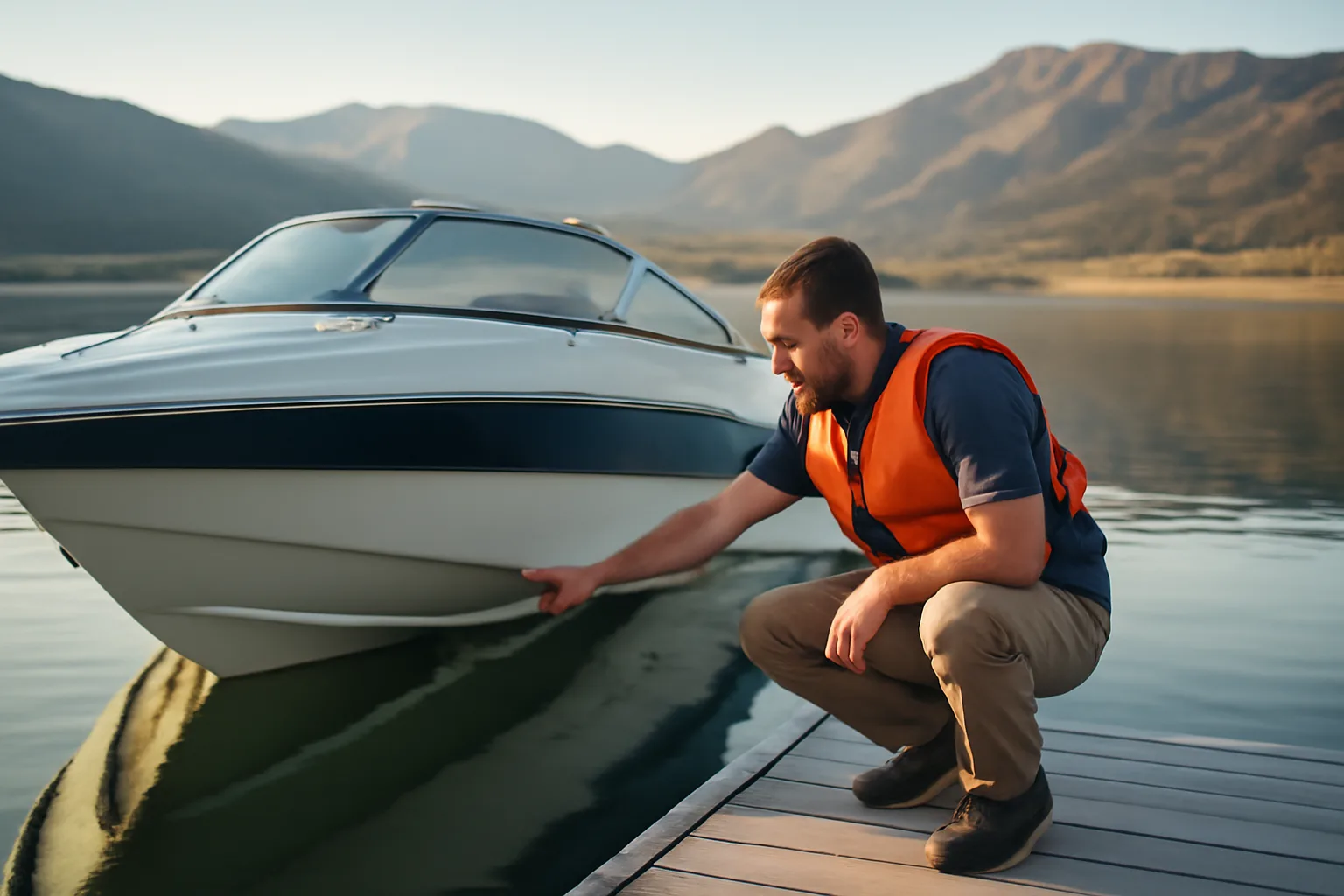
The work is inspection and documentation. You show up at a marina or storage facility, examine the vessel systematically, and write a report the client, their lender, or their insurer uses to make a decision.
In Utah the common survey types are pre-purchase inspections and insurance surveys. Pre-purchase surveys happen when someone buys a used boat and wants an independent read on condition and value. Insurance surveys happen when an underwriter wants an updated assessment before writing or renewing a policy on an older or higher-value vessel.
The physical inspection covers hull condition (for trailerable boats that often means topsides and the trailer bunk contact points), structural integrity, mechanical systems, electrical systems, safety equipment, and cosmetic issues that affect value. ABYC (American Boat and Yacht Council) standards form the technical baseline for electrical and systems inspection. Knowing those standards well is not optional [7].
Report writing takes as long as the inspection for many surveyors. A good report is detailed enough that someone who was not there understands exactly what you found, where you found it, and why it matters. Weak reports are the top reason new surveyors fail to build repeat business.
Around the Colorado River corridor, which includes Lake Powell, you will occasionally see larger offshore-capable vessels that owners trailered in. That stretches the scope beyond typical freshwater craft. Worth being ready for.
Are there federal requirements that affect Utah marine surveyors?
A few federal frameworks are worth knowing, though none license you as a marine surveyor.
If you survey a documented vessel (one enrolled in the U.S. Coast Guard's National Vessel Documentation Center system rather than titled by a state), you are working with a federally registered asset [8]. NVDC documentation does not change your role as a surveyor, but it is context you need when you review ownership documents and encumbrances.
The Coast Guard's vessel inspection programs apply to commercial and passenger vessels, not to private recreational craft. If you move into commercial vessel surveying, federal inspection and classification standards get much more relevant, and that work often requires extra training and sometimes a Coast Guard merchant mariner credential depending on the role [2].
For most Utah surveyors working recreational vessels on state waterways, the federal layer is background knowledge, not a direct compliance burden.
Utah state boating law, administered by Utah State Parks, governs vessel registration, safety equipment requirements, and operator conduct on state waters [9]. Knowing the Utah safety equipment requirements is practically useful because it is part of what you assess during a survey.
How does Utah compare to states that do license marine surveyors?
Almost no state licenses marine surveyors, so this comparison is about what does not exist rather than what does.
A handful of states have explored regulations touching marine professionals. As of this writing, no U.S. state maintains a dedicated marine surveyor license program comparable to, say, a real estate appraiser license. The profession is self-regulated through SAMS and NAMS nationwide.
What varies by state is boating market size and the density of surveyors serving it. Florida, California, and the Great Lakes states have the highest concentrations of working surveyors because they have the largest boat populations. Utah is a smaller market with seasonal demand centered on its reservoirs and the Lake Powell corridor.
For comparison, see how neighboring states handle the same non-issue:
- Marine surveyor license in Arizona: no state license, similar desert-lake market.
- Marine surveyor license in Colorado: no state license, mountain reservoir market.
- Marine surveyor license in California: no state license but a much larger coastal market with established surveyor networks.
The practical effect of Utah's non-licensing: the barrier to entry is low, and so is the built-in credential signal. That makes association membership more important, not less. It is the only standardized signal available to clients who cannot lean on a state-issued credential.
How do you find work as a marine surveyor in Utah?
Utah's boating market centers on a few bodies of water. Lake Powell (split between Utah and Arizona), Bear Lake on the Idaho border, Deer Creek Reservoir, Flaming Gorge, and Utah Lake generate most of the demand. Boat dealers in the Salt Lake City metro, St. George, and around Lake Powell access points are your most natural referral sources.
Marina relationships matter more than advertising in a market this size. Introduce yourself to marina managers and service yards. When a buyer asks the marina who to call for a survey, you want your name to come up. That does not happen without the in-person groundwork.
Insurance agents and yacht brokers (the term gets used loosely even for freshwater dealerships) are strong referral sources too. They need surveys regularly and they need surveyors who turn reports around fast. Reliability and turnaround often matter more to repeat referrers than the specific credential you hold, though an AMS or CMS still helps.
List yourself in the SAMS and NAMS surveyor directories. That is table stakes. Both organizations maintain searchable databases clients use to find credentialed surveyors in their area [3][4]. If you are not listed, you are invisible to anyone who knows to look there.
Still in the study phase before your exam? The MarineSurveyKit prep kit at /start is worth a look for SAMS and NAMS exam prep specifically. Covering the content systematically beats piecing study materials together on your own.
What training and education do Utah marine surveyors typically pursue?
There is no required degree or formal schooling. Most working surveyors come from boat repair, marine mechanics, yacht brokerage, or general construction, and bring trade knowledge that translates directly to knowing what they are looking at during an inspection.
The ABYC Standards and Technical Information Reports are the foundation for the electrical and systems portion of both the SAMS and NAMS exams, and for the work itself [7]. ABYC runs its own training and certification programs, and many surveyors hold at least a basic ABYC electrical certification before they sit for their association exam.
SAMS and NAMS both offer education at annual conferences and through online courses. Quality varies. Some modules are genuinely useful. Others are basic. The value of conference attendance is as much the networking and peer review as the formal instruction.
The BoatUS Foundation offers boating safety and seamanship courses that build useful background, especially if you did not come up through recreational boating yourself [10]. These are not part of the credentialing path, but they build vocabulary and context.
For exam prep specifically, structured self-study is often the most efficient route for someone balancing study with the early stages of building a practice. The exam tests systems knowledge, report standards, and ethics more than boat-spotting ability.
Frequently asked questions
Do you need a license for marine surveyor in Utah?
No. Utah does not issue or require a state marine surveyor license. The Utah Division of Occupational and Professional Licensing does not regulate this occupation. You can legally perform and charge for vessel surveys without any state credential. What matters in practice is voluntary professional designation from SAMS International (AMS) or NAMS (CMS), which clients and insurers rely on in the absence of state licensing.
How much does a marine surveyor cost in Utah?
For clients hiring a surveyor, expect roughly $20 to $35 per foot of vessel length for a pre-purchase survey, so a 25-foot boat runs about $500 to $875. Insurance surveys sometimes cost less. For someone building a career, certification costs run $2,500 to $6,000 over the first few years, covering association dues, exam fees, and training. There are no Utah state fees because no state license exists.
How long does it take to become a marine surveyor in Utah?
Plan on 2 to 4 years from starting as an associate member of SAMS or NAMS to earning full accreditation (AMS or CMS). You can schedule the exam within your first year once you meet prerequisites, but the experience documentation requirement drives the timeline. Utah's seasonal boating market, concentrated between April and October, can slow your hour accumulation compared to year-round coastal markets.
Which is better for Utah, SAMS or NAMS?
For the recreational freshwater market Utah has, both work. SAMS tends to be more visible in the pleasure craft insurance and pre-purchase market. NAMS has historically had stronger commercial ties. Talk to working surveyors in the region before committing. Some eventually join both, but that is a later-career decision. Start with whichever association has more active members in your target area so you can connect with mentors.
Do Utah marine surveyors need to register a business?
Not for the survey work itself, but standard Utah business rules apply. If you use a trade name or form an LLC, you register with the Utah Division of Corporations and Commercial Code. LLC formation costs roughly $54. If you operate as a sole proprietor under your own legal name, no DBA filing is required, though a federal EIN from the IRS is free and useful for separating business and personal tax identity.
Is there a Utah-specific boating regulation I should know as a surveyor?
Yes. Utah State Parks administers boat registration and safety equipment requirements under state boating law. Knowing the required safety equipment for vessels by size and type is practically useful because it is part of what you assess. Utah also requires boater education for operators born after a set date under state law. These rules affect what you check for, not your own license status.
Can I survey vessels on Lake Powell as a Utah-based surveyor?
Yes. Lake Powell straddles the Utah-Arizona border, and no state surveyor license in either Utah or Arizona would restrict you. Your professional association credential (SAMS AMS or NAMS CMS) is what clients care about, and those are national credentials. Just be aware that Lake Powell vessels vary widely in size and type, so make sure your competency covers the range of craft you agree to survey.
Do I need any Coast Guard credential to work as a marine surveyor in Utah?
No. U.S. Coast Guard licensing applies to vessel operators (merchant mariners, captains) rather than surveyors. For recreational vessel survey work in Utah, no federal credential is required. If you move into commercial vessel work or formal marine classification, the credential landscape shifts considerably, but that is a different specialty from the recreational market most Utah surveyors focus on.
What tools do I need to start doing marine surveys in Utah?
The minimum kit is a quality moisture meter (Sovereign or Tramex are commonly used brands), a strong flashlight, measuring tape, camera, and a laptop or tablet for report writing. A complete professional kit adds a borescope, gas vapor detector, and basic electrical testing equipment. Budget $1,000 to $3,000 for a solid starting kit. Tools are a one-time capital expense, not a recurring cost.
Does Utah require errors and omissions insurance for marine surveyors?
Utah has no state requirement for E&O insurance for marine surveyors. Carrying professional liability (E&O) insurance is still a practical necessity. Clients with high-value vessels and lenders financing purchases sometimes ask for proof of coverage. Annual premiums for a sole-practitioner surveyor typically run $1,000 to $3,000 depending on coverage limits and claims history. Confirm current market rates with a marine industry insurance broker.
Are there marine surveyor jobs (salaried positions) in Utah, or is it always self-employment?
Almost all marine surveyors in Utah are self-employed sole proprietors or single-person LLCs. Salaried marine surveyor positions do exist nationally, mostly at marine insurance companies, large brokerage firms, or salvage operations, but those are rare and concentrated in coastal markets. In Utah, expect to build your own client base rather than joining an existing firm.
How do I get my first survey clients in Utah without an established reputation?
Start with marinas and boat dealerships around Salt Lake City, St. George, and Lake Powell access points. Introduce yourself in person. Associate-level SAMS or NAMS membership lets you list yourself in their directories immediately, which is your first searchable presence. Insurance agents writing boat policies are another early referral source. Be honest about your experience level; most clients prefer an honest associate over an overconfident one.
Do neighboring states like Arizona or Colorado have different marine surveyor rules?
No. Arizona and Colorado also have no state marine surveyor license. The situation is essentially identical across all three states. Professional SAMS or NAMS credentials are the market standard regardless of which state you operate in. See the Arizona and Colorado guides on this site for any state-specific business registration details that might differ slightly from Utah's requirements.
Sources
- Utah Division of Occupational and Professional Licensing: Marine surveyor is not listed as a regulated occupation by Utah DOPL
- U.S. Coast Guard, Mariner Credentialing Program: Coast Guard merchant mariner credentials apply to vessel operators, not marine surveyors
- SAMS International (Society of Accredited Marine Surveyors): SAMS AMS accreditation requires documented survey experience, exam, and report portfolio review; annual dues and exam fees apply
- National Association of Marine Surveyors (NAMS): NAMS CMS credential requires experience, examination, and annual membership fees
- Utah Division of Corporations and Commercial Code: Utah LLC formation filing fee is approximately $54; DBA and entity registration required
- IRS, Apply for an Employer Identification Number (EIN) Online: Federal EIN registration is free and available online for sole proprietors and entities
- American Boat and Yacht Council, Standards and Technical Information Reports: ABYC standards form the technical baseline for electrical and systems inspection in marine surveys
- U.S. Coast Guard, National Vessel Documentation Center: NVDC administers federal documentation for enrolled vessels; surveyors reviewing documented vessels work with federally registered assets
- Utah State Parks, Boating: Utah State Parks administers boat registration and safety equipment requirements under state boating law
- BoatUS Foundation, Boating Safety Courses: BoatUS Foundation offers boating safety and seamanship courses useful for background knowledge